
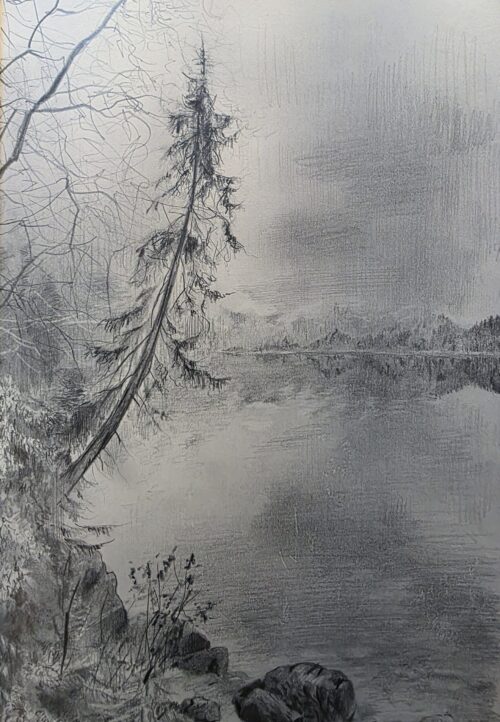
Eibsee No 1
2024, pencil on colored paper, 29,5 x 21 cm
Landscape has never been the central figure in my paintings; it has always remained a background — a space in which the action unfolds. Yet it is precisely from the landscape, from this background, that a new phase of my work begins after an almost decade-long pause.
All the works in this series depict the Alps — German, Swiss, and Italian. It is, without question, one of the most beautiful places on earth. The drawings presented here are not finished works, but preparatory studies for larger compositions yet to come.
At the centre of these future compositions will stand Ludwig II of Bavaria. They are conceived as a continuation of the painting Formula of Eternity, or Ludwig II of Bavaria and the Ghost (2012).
Why Ludwig II? Perhaps the answer lies in his residence on the Schachen — less known than his other castles, yet, to my mind, the most “Ludwig-like” of them all. The Schachen is not merely one among many pavilions or kiosks built in 19th-century Europe under the influence of Orientalist fashion. It is a distilled model of the inner world of an extraordinary individual — a world that found material form in his Alpine architecture.
These are not castles in the conventional sense. They do not imitate medieval fortresses or Renaissance palaces. They are symbolic constructions — spaces of withdrawal. Within them, the king sought refuge from the hostile, so-called “real” world, entering instead a reality shaped by his own imagination.
The so-called hunting lodge, built in the style of a Swiss chalet and containing the “Turkish Hall,” becomes a kind of mirror-world — an inversion of reality. Both the Schachen and the Alps themselves form a landscape that conceals within it a spirit of contemplation — an invitation to turn inward and encounter a deeper, spiritual dimension of reality.
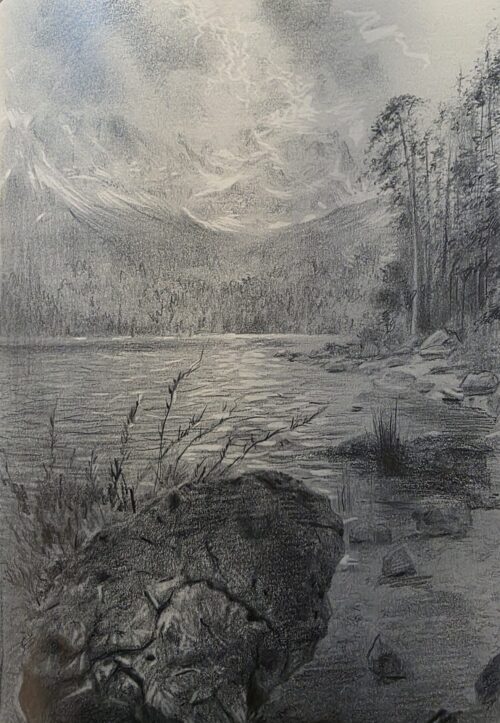
Eibsee No 2
2024, pencil on colored paper, 29,5 x 21 cm
The distance from Lake Eibsee to the royal residence on the Schachen is approximately 7–8 km in a straight line. However, the actual hiking route is considerably longer and more demanding due to the mountainous terrain. Lake Eibsee lies at the northern foot of the Zugspitze, the highest mountain in Germany. Unlike the Schachen, Eibsee is a popular tourist destination. For this reason, the best time to experience its views is either early in the morning or at sunset, when the cable car to the Zugspitze has already stopped operating.
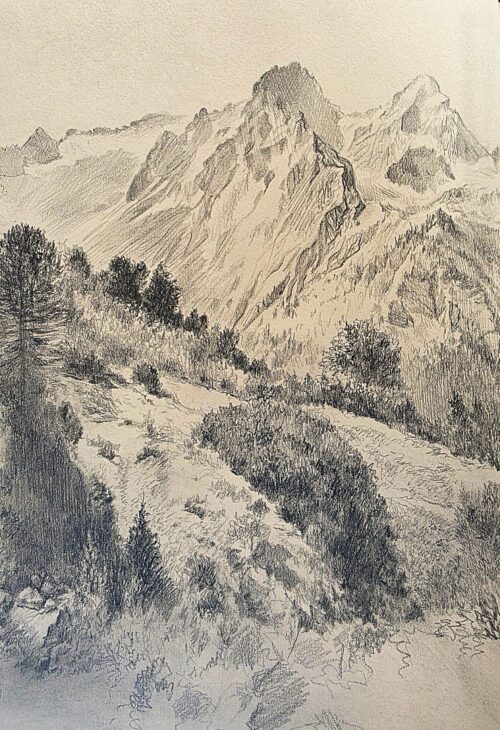
On the way to Schachen
2024, pencil on colored paper, 29,5 x 21 cm
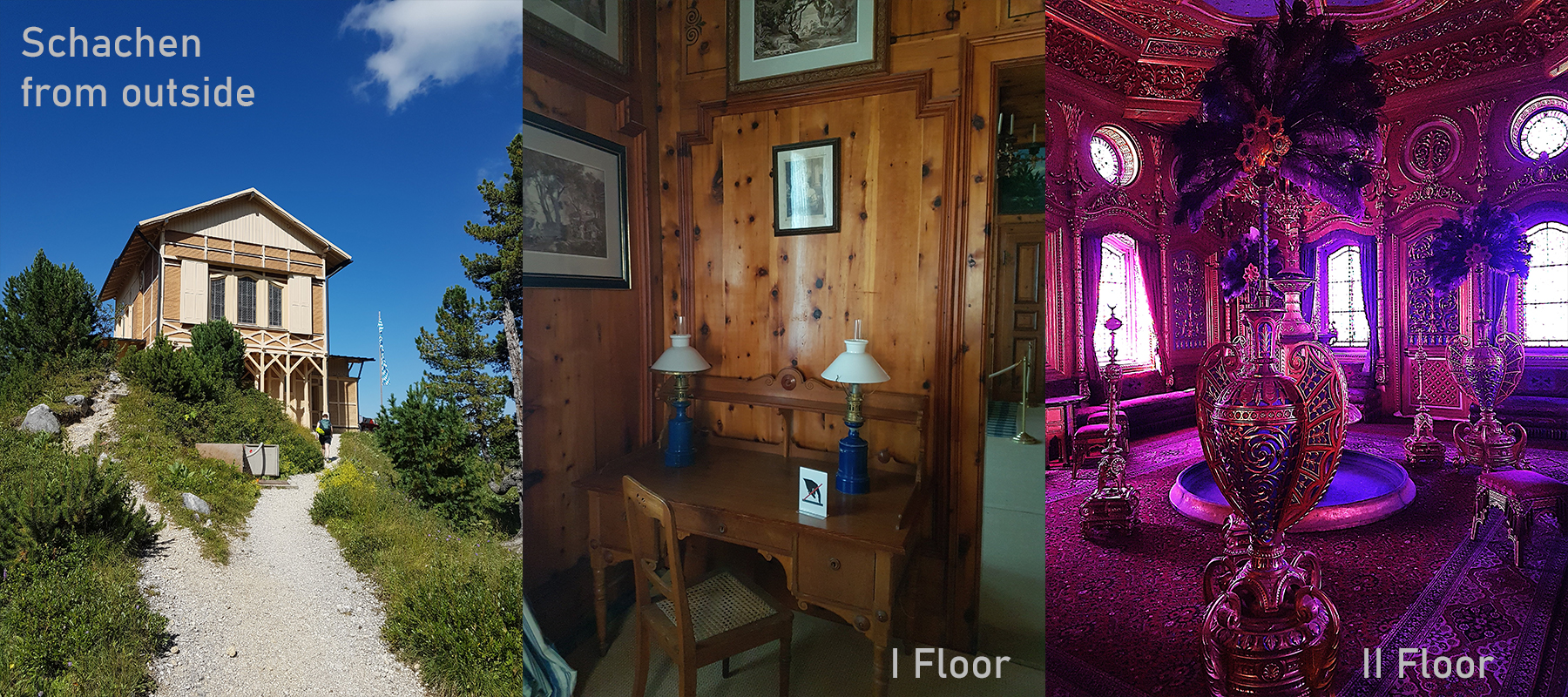
The Schachen is not simply a house in the mountains. It is a multi-layered conceptual structure. Unlike Ludwig’s other castles, it is difficult to access. Situated at an altitude of 1,866 metres above sea level, it can only be reached on foot or by mountain bike.
According to the Bayerische Schlösserverwaltung, the journey from Garmisch-Partenkirchen takes between six and seven hours (approximately 10 km one way), while the route from Mittenwald is about 15 km and takes five to six hours one way. The residence is open to visitors only from June to October, meaning that the ascent takes place during the warmest part of the year. Entry is possible only as part of a guided tour, with the last one starting at 15:00.
If you reach the site but fail to enter, its inner meaning remains inaccessible, as it can only be grasped through the experience of its interiors across both floors. Darkness falls early in the mountains, and if you begin your descent at 16:00, you are unlikely to reach the nearest settlements before nightfall.
Ludwig had a tradition of celebrating his birthday here on August 25. He built the residence in order to be mit sich allein — alone with himself — and did not intend it for mass visitation. The very path leading to the building can be understood as part of the high-altitude concept.
The Schachen was built between 1870 and 1872. In 1927, Carl Gustav Jung published his essay “Seele und Erde” (“Soul and Earth”), in which his description of the structure of the psyche offers a striking parallel to this mountain residence:
“The structure of the psyche and its relation to the earth and the world (its chthonic part) may be compared to a building whose upper storey was erected in the nineteenth century, the ground floor dates from the sixteenth century, and a closer examination of the masonry reveals that it was reconstructed from a tower of the eleventh century. In the cellar we discover Roman foundations, and beneath the cellar lies a filled-in cave, in the upper layers of which we find stone implements, and in the deeper layers, remains of prehistoric fauna. This image gives us an idea of the structure of our psyche: we live on the upper floor and are only dimly aware that the lower floor is something very ancient. What lies beneath the surface is entirely beyond our consciousness. Yet this comparison falls short, for in the psyche nothing is a dead relic — everything is alive, and our upper floor — consciousness — is under the constant influence of the living and active foundation on which, like the whole building, it rests.”
On the upper floor of the Schachen is the so-called “Turkish Hall,” while the lower level corresponds precisely to Jung’s description, being designed in the Renaissance style. As for the foundation upon which the residence stands, it is the Wetterstein massif, part of the Northern Limestone Alps, composed primarily of carbonate rocks of Mesozoic origin formed in a tropical sea. The dominant rock type is Wetterstein limestone — a dense, light-grey material that forms steep walls and sharp peaks, including Germany’s highest point, the Zugspitze (2,962 m).
The upper floor with the “Turkish Hall” is the final level. Although it is called “Turkish,” it is in fact a Western fantasy on an Eastern theme. According to Jung, it was precisely the East that, from the late eighteenth century onward — after the French Revolution had enthroned the Goddess of Reason upon the altar of a Christian church — became a spiritual refuge for Western man, deprived of religion.
In “The Aims of Psychotherapy,” Jung writes that we never rise above fantasy, and that the psyche is indifferent to our categories of reality. In this realm of so-called fantasy — that is, the spiritual world, which acts in a very real way — the central element is the scientifically unprovable “fantasy” of the soul’s immortality. The high-altitude residence of Ludwig can undoubtedly be seen as a monument to this idea.
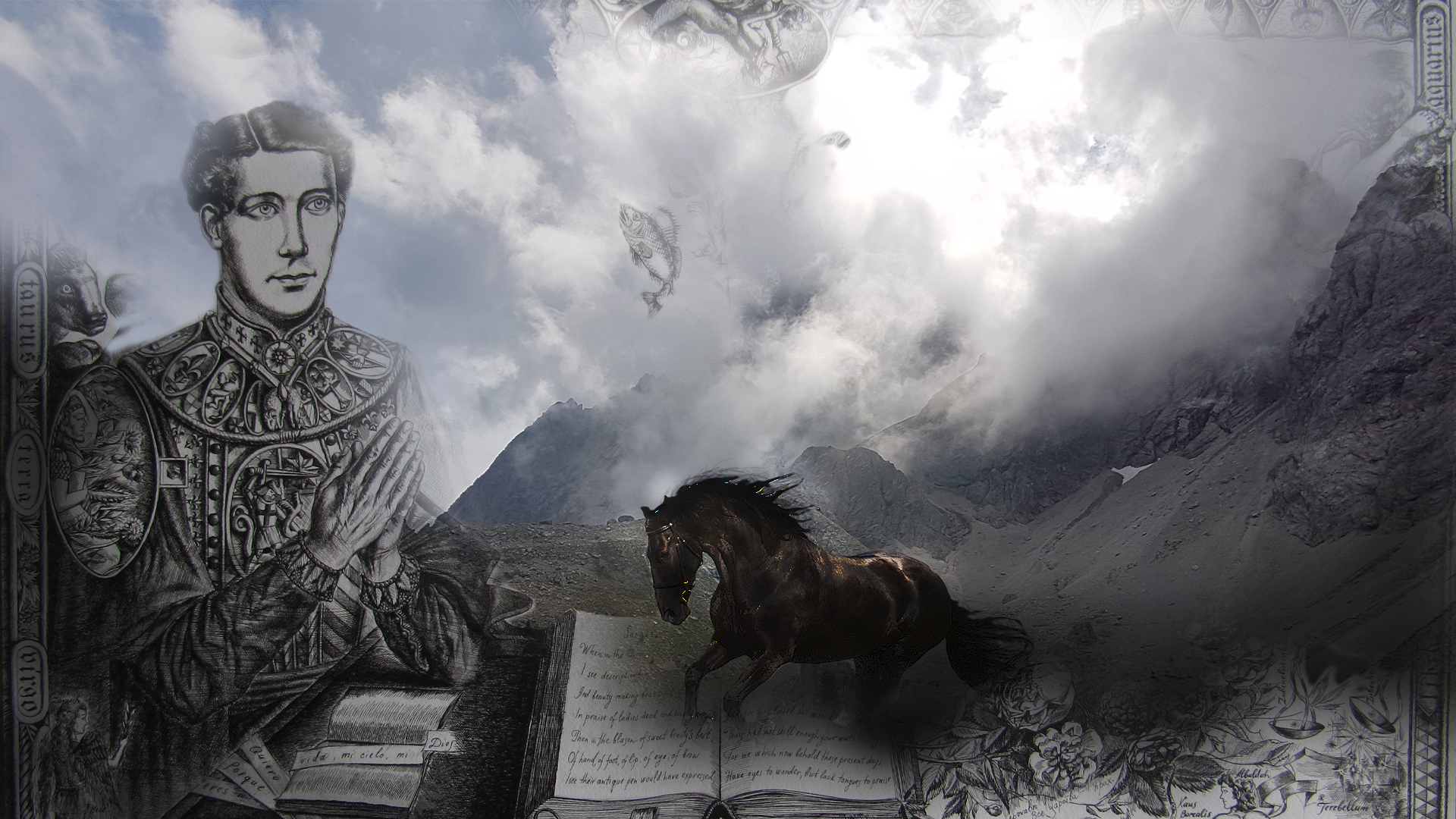
“Ludwig II in the Mountains”
based on “Eternity Formulae, or Ludwig II of Bavaria and The Ghost”, 2024


